Heat Pump Basics

What is an Air-Source Heat Pump?

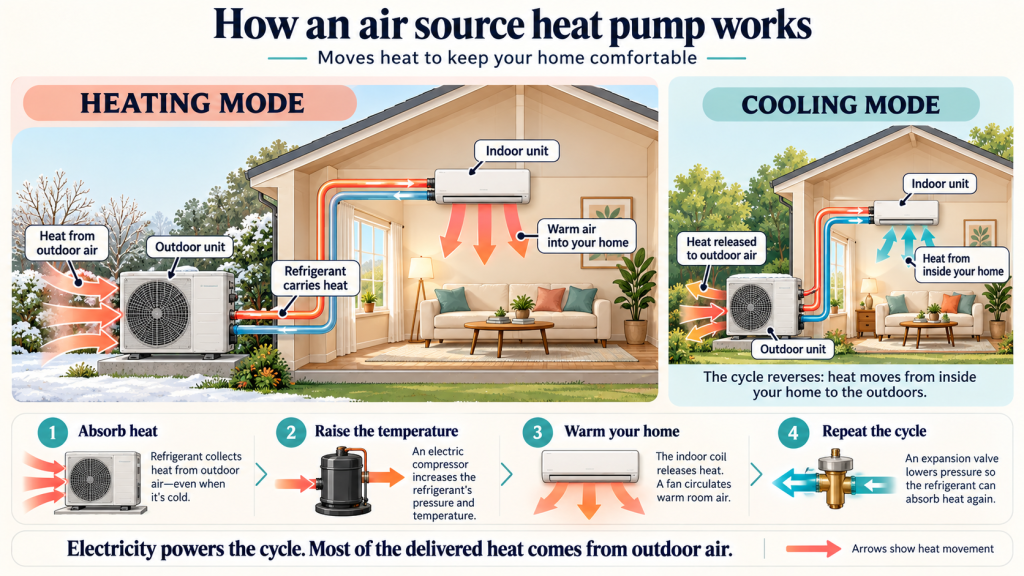
An air-source heat pump is an all-in-one heating and cooling system that keeps your home comfortable throughout the year. It heats your home in the winter and cools it in the summer.

Unlike furnaces or boilers that create heat by burning fuel, a heat pump moves heat from one place to another using electricity. It works much like a refrigerator, which moves heat from inside the fridge to your kitchen. In winter, a heat pump takes heat from the outdoor air and moves it inside your home. In summer, it does the opposite, removing heat from inside your home and releasing it outdoors. Even when it’s below freezing outside, there is still heat energy in the air. Modern cold-climate heat pumps are designed to capture this heat and provide reliable heating, even during cold winters.

A heat pump has an outdoor unit, called a condenser, connected to one or more indoor units by small refrigerant lines. A special fluid called refrigerant circulates through the system, carrying heat between the indoors and outdoors. This process repeats continuously to maintain your desired indoor temperature. Because heat pumps move heat instead of generating it, they are much more energy efficient than electric baseboard heaters. They also provide highly efficient air conditioning, so one system can handle both heating and cooling.

A common misconception that many people believe is that heat pumps stop working when temperatures drop below freezing or always need a backup heating system. In reality, modern cold-climate air-source heat pumps are specifically designed to operate efficiently in freezing temperatures. In well-insulated homes, they can often provide all the heating and cooling needed throughout the year without a backup system.
Types of Air-Source Heat Pumps

There are two main types of air-source heat pump systems: ducted and ductless. Some homes also use a combination of both to provide the best comfort and efficiency.
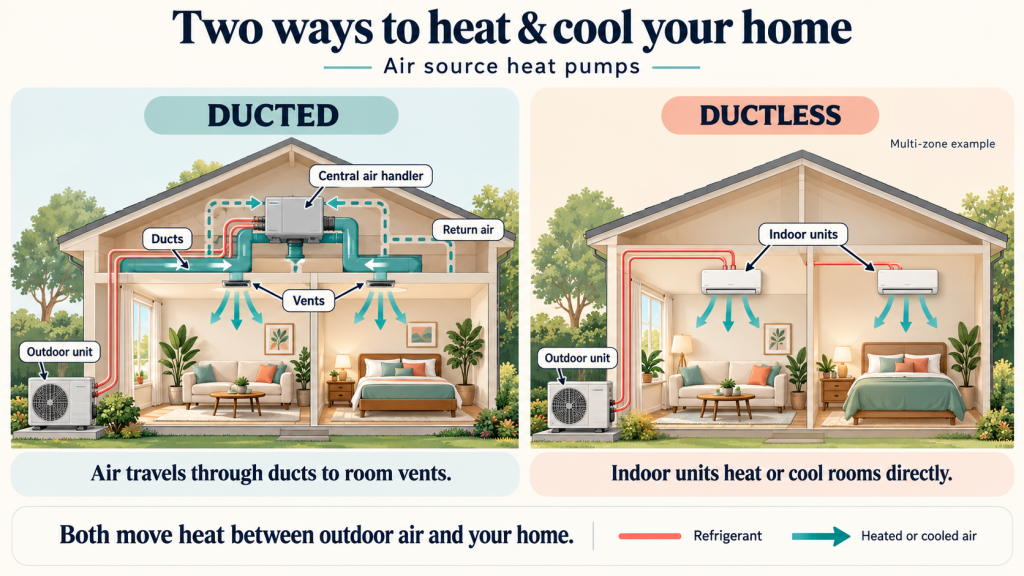
  • Ducted Heat Pump – A ducted heat pump works with a home’s air ducts, much like a traditional central heating and air conditioning system. An outdoor unit connects to an indoor unit, which distributes heated or cooled air through the ductwork to different rooms. Ducted systems are a good choice for homes that already have ducts or for homeowners planning to install them.
  • Ductless Heat Pumps (Mini-Splits) – Ductless heat pumps, often called mini-splits, do not require ductwork. They have an outdoor unit connected to one or more indoor units by small refrigerant lines. Each indoor unit is typically installed in a single room or open living area and can be mounted on a wall, near the floor or in the ceiling. Because each unit can be controlled separately, homeowners can set different temperatures in different parts of the home. Ductless systems are an excellent option for homes without existing ductwork or for heating and cooling specific areas, such as home additions, finished basements, or rooms that are difficult to keep comfortable.

Types of Air-Source Heat Systems

Heat pumps can be designed to heat and cool one area or several areas of a home.

  • Single-zone systems use one outdoor unit connected to one indoor unit. The indoor unit may serve a single room with a ductless unit or multiple rooms if it is connected to ductwork.
  • Multi-zone systems use one outdoor unit connected to several indoor units. Each indoor unit creates its own temperature zone, allowing different rooms to be heated or cooled independently. Some multi-zone systems can include both ducted and ductless indoor units.
  • Combining Ducted and Ductless Systems – Many homes use a combination of ducted and ductless heat pumps. For example, a home with existing ductwork may use a ducted system for the main living areas and add a ductless unit for a new addition or another space where extending the ductwork would be difficult or expensive. This flexible approach allows homeowners to choose the best solution for each part of their home.

Heat Pump Benefits

COST

  • Municipal electric rates are some of the lowest in the state, so the cost to operate heat pumps is often less expensive to operate than oil, propane, or electric resistance heat
  • NextZero rebates can help to defray some of the installation costs

FLEXIBILITY & FUNCTION

  • Provide heating and cooling in one energy efficient system
  • Can be ductless or ducted to meet your home’s needs
  • Ductless indoor units are versatile giving the homeowner the choice of floor, ceiling or wall-mounted units
  • Operates efficiently in cold-climate regions, like Massachusetts
  • Cold-climate air-source heat pumps can be the sole source of heating and cooling in a well-insulated home
  • Adaptable for many situations. Air-source heat pumps can:
    • Fully replace your existing heating system
    • Integrate with your existing system
    • Supplement your existing system 

COMFORT

  • Allows for single or multiple zone temperature control
  • Indoor air handling units are significantly quieter and are more visually pleasing than window air conditioners
  • Outdoor condensing units are much quieter than central air conditioning outdoor units

HELPING THE ENVIRONMENT

  • Air-source heat pumps run on electricity instead of burning oil, propane or natural gas. Because they do not burn fossil fuels to heat your home, they can reduce your home’s greenhouse gas emissions while providing efficient heating and cooling.